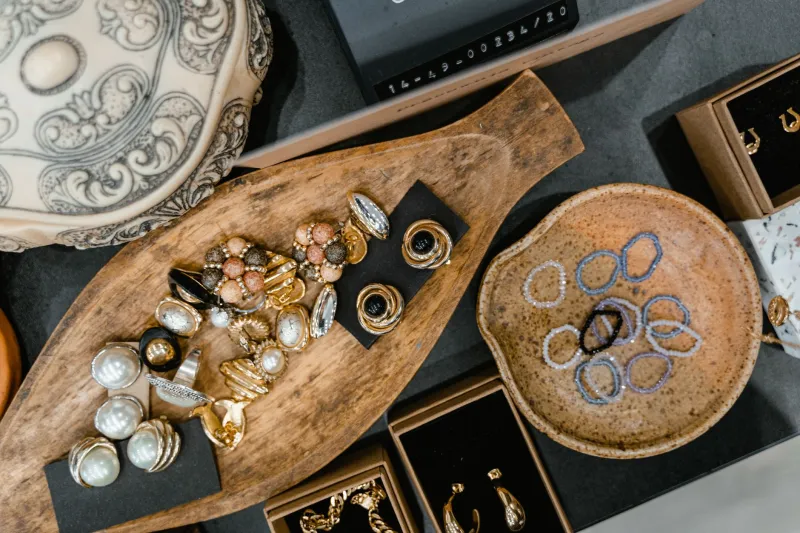
Dress Code Dismissed: The Case for Wearing Jewelry That Moves You, Not Just Matches You

Photo by Photo by Vann on Unsplash on Unsplash
For decades, the prevailing wisdom around jewelry styling could be distilled into a single, suffocating instruction: match. Match your metals. Match your occasion. Match the formality of your outfit, the color of your handbag, the hour of the day. The rules were plentiful, the gatekeepers were confident, and the result — for far too many collectors — was a jewelry box full of pieces worn far less often than they deserved.
Something has shifted. Quietly but unmistakably, the most stylistically assured individuals in America are walking out the door wearing what they love, not what the rulebook prescribed. They are layering an heirloom Victorian brooch over a crisp blazer. They are pairing a substantial cocktail ring with weekend denim. They are mixing rose gold with yellow gold with silver, and they are doing it not out of carelessness, but out of a considered, deeply personal conviction. The jewelry box rebellion is well underway.
The Tyranny of the Matching Principle
It is worth understanding how the matching imperative took hold in the first place. For much of the twentieth century, jewelry was treated as a finishing detail — a punctuation mark applied to an already-complete outfit. The logic was architectural: if the clothes provided the structure, the jewelry simply had to align with it. Pearls with formal wear. Gold hoops with casual looks. Nothing too unexpected, nothing that might distract.
This framework was never really about aesthetics. It was about legibility — the desire to signal, clearly and correctly, one's social position and sartorial competence. Jewelry worn according to the rules communicated that its owner understood the rules. It was a form of conformity dressed up as taste.
The problem, of course, is that conformity and genuine personal style are fundamentally incompatible. A piece of jewelry chosen because it coordinates is a piece chosen for its deference. A piece chosen because it resonates is an entirely different matter.
What Emotional Resonance Actually Means
When collectors speak about a piece that feels right, they are describing something that transcends aesthetics. It is the weight of a cuff that has been in the family for three generations. It is the particular green of a tourmaline that has no rational relationship to anything else in the wardrobe but feels, inexplicably, essential. It is the bold geometry of a statement earring that has nothing to do with Tuesday morning but everything to do with who you are on a Tuesday morning.
Emotional resonance is the quality that makes a piece of jewelry feel like an extension of identity rather than an accessory to clothing. And here is what the old rulebook never accounted for: identity does not coordinate. It accumulates. It contradicts itself. It evolves. The most authentic jewelry looks are the ones that reflect this complexity rather than smoothing it away.
The Art of the Intentional Mismatch
There is an important distinction to be drawn between careless mismatching and intentional mismatching. The former is simply inattention. The latter is a sophisticated compositional choice — one that requires, paradoxically, more awareness than conventional coordination.
Consider the collector who wears a delicate diamond pavé necklace alongside a bold, hand-hammered bronze cuff. On paper, the pairing should not work. In practice, the contrast creates a visual conversation that neither piece could generate alone. The refinement of one amplifies the rawness of the other. The result is more interesting, more alive, more expressive than any perfectly matched set could hope to be.
This is the principle that skilled stylists and confident dressers have long understood: tension, when it is deliberate, is not a flaw. It is the source of vitality.
Asking the Right Question
The shift from does this go with my outfit? to does this feel right? may seem subtle, but it represents a fundamental reorientation of the collector's relationship with her jewelry. The first question positions the clothing as the authority and the jewelry as the subordinate. The second positions the wearer as the authority and both the clothing and the jewelry as expressions of her.
This reorientation has practical consequences. It means reaching for a piece because it reflects your mood on a particular morning, not because it is technically appropriate for the occasion. It means wearing the ring that belonged to your grandmother to a business dinner, not because it matches your dress, but because carrying that connection into the room matters to you. It means trusting that the confidence generated by wearing something you genuinely love will read more powerfully than any carefully coordinated ensemble.
And it does. There is a quality of ease and authority that attaches itself to people who wear jewelry on their own terms. It is visible in the way they move, in the way they speak about what they are wearing when someone inevitably asks. They are not reciting a styling rationale. They are telling a story.
The Collections That Thrive Under This Philosophy
It is worth noting that this approach is particularly well-suited to the kind of thoughtfully assembled collection that BijOnline has always championed — one built around pieces of genuine quality and individual character rather than matching sets or trend-driven acquisitions.
A collection composed of pieces chosen for their intrinsic merit, their craftsmanship, their personal significance, is a collection that can be worn in an almost infinite number of combinations. Each piece is strong enough to stand independently. Each carries its own story. When two such pieces are brought together — even unexpectedly, even in apparent defiance of convention — the result tends to be richer than the sum of its parts.
This is precisely why the collectors who invest in quality over coordination find that the rebellion feels not like rule-breaking but like liberation. When every piece in your box is genuinely yours — chosen because it moved you, not because it matched — the question of coordination becomes secondary almost automatically.
Permission Granted
If you have been waiting for someone to formally release you from the matching imperative, consider this that release. The most compelling jewelry looks are not the most coordinated ones. They are the most honest ones — the looks that communicate something true about the person wearing them, that carry meaning beyond the visual, that make a room a little more interesting simply by entering it.
Wear the brooch with the blazer. Stack the mismatched metals. Put on the statement ring on a Wednesday. Ask not whether it goes with the outfit, but whether it goes with you. The answer, when you are wearing something you truly love, will almost always be yes.