Stacking with Intention: How to Build a Layered Jewelry Look That Is Entirely Your Own
There is a quiet confidence that comes with wearing jewelry that feels genuinely composed rather than casually assembled. Layering fine pieces and bijoux — whether across the neckline, wrist, or fingers — has become one of the most compelling expressions of personal style in contemporary American fashion. Yet the difference between a look that reads as effortlessly curated and one that appears cluttered often comes down to a handful of guiding principles.
At BijOnline, we believe that jewelry is not merely ornament. It is narrative. Each piece you choose carries weight — literal and symbolic — and understanding how those pieces speak to one another is the foundation of truly elevated layering.
Understanding the Architecture of a Layered Necklace Look
Begin with structure before you reach for your jewelry box. A well-layered necklace arrangement follows a clear hierarchy of length. The most flattering starting point is a choker or a 14- to 16-inch chain worn close to the collarbone. From there, introduce a second piece at approximately 18 inches, and a third at 22 to 24 inches if the neckline and occasion permit.
The key is contrast, not uniformity. Pairing a delicate diamond solitaire pendant on a fine cable chain with a slightly heavier gold link necklace of a different length creates visual interest without competition. Each piece occupies its own visual lane. When two necklaces share the same length and weight, they tend to tangle both physically and aesthetically, undermining the intentionality you have worked to establish.
Consider, too, the neckline of your garment. A deep V-neck invites a single longer pendant to follow the line naturally, while a crewneck or boat neck creates a stage for shorter, statement-forward layering. American women have increasingly embraced the practice of dressing their necklines with the same deliberateness they bring to selecting a handbag — and the results speak for themselves.
The Case for Mixing Metals
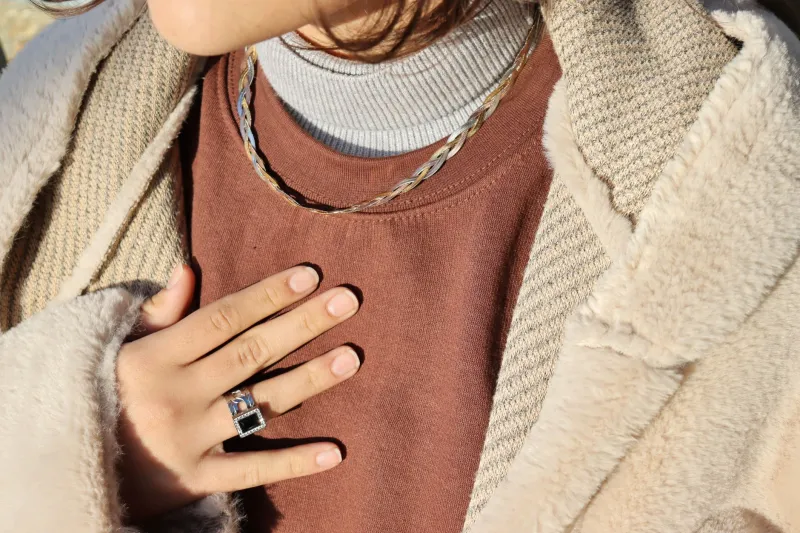
For years, the prevailing advice held that mixing gold and silver was a stylistic misstep. That convention has been thoughtfully retired. Today, the most sophisticated layered looks often blend yellow gold, white gold, rose gold, and sterling silver with purposeful ease.
The governing principle is not uniformity of metal but rather unity of aesthetic. If your pieces share a similar level of refinement — all fine jewelry, for instance, or all high-quality bijoux — the eye reads them as a coherent family regardless of their metal tone. A yellow gold initial charm layered with a white gold diamond bar necklace feels luxurious precisely because the contrast is intentional.
When mixing metals, consider anchoring the look with one dominant metal that appears in at least two of your pieces. This creates a through-line that prevents the arrangement from feeling arbitrary. Rose gold, in particular, has demonstrated remarkable versatility as a bridging tone, flattering both the warmth of yellow gold and the coolness of silver.
Proportion and Scale: The Rules Worth Following
Proportion is the silent architect of every successful layered look. The most common error is placing pieces of identical visual weight side by side. Instead, think in terms of scaling: one piece should always read as the anchor, with the others serving as complements.
For necklaces, the anchor is typically the most substantial piece — whether in chain weight, pendant size, or gemstone presence. For rings, the anchor is the statement ring, often worn on the index or middle finger, with simpler bands and stacking rings flanking it on adjacent fingers. For bracelets, a single cuff or tennis bracelet can anchor an arrangement of fine chain bracelets and delicate bangles on the same wrist.
American women who have mastered this approach often speak of the "rule of three" — choosing three pieces for a given body zone and ensuring they vary in at least two of the following: length, weight, texture, and metal tone. This simple framework produces arrangements that feel deliberate and dynamic in equal measure.
Occasion Dressing: Adapting Your Layers
The beauty of a well-curated jewelry wardrobe is its adaptability. The same foundational pieces can be reconfigured for vastly different occasions by adding or subtracting a single element.
For professional settings, consider a restrained two-piece neckline arrangement — perhaps a fine gold chain paired with a single gemstone pendant — alongside a single stacking ring and one understated bracelet. The overall effect is polished without distraction.
For evening occasions, the same foundational necklace might be joined by a more dramatic third layer featuring pavé detailing or a pendant of greater presence. Adding a diamond tennis bracelet to your wrist arrangement immediately elevates the ensemble. The pieces themselves need not change dramatically; the composition does.
For weekend and casual styling, bijoux pieces — colorful enamel charms, beaded bracelets, playful hoop earrings — can be woven into arrangements alongside fine jewelry without diminishing either. This is, in fact, one of the most exciting developments in contemporary American jewelry culture: the dismantling of the hierarchy between fine jewelry and fashion-forward bijoux.
Building Your Personal Signature
The most admired jewelry layering is never purely technical. It carries something of the wearer within it. Perhaps it is a vintage brooch repurposed as a pendant, or a birthstone ring that anchors an otherwise neutral stack. Perhaps it is the consistent presence of a single metal tone that ties every arrangement together across seasons.
Begin by identifying the pieces you reach for instinctively — those are your anchors, your non-negotiables. Build outward from them. Invest in a small collection of fine chain necklaces in varying lengths and weights, a set of simple gold or silver bands for stacking, and two or three bijoux pieces that reflect your personality rather than the season's trends.
At BijOnline, our curation is built around exactly this philosophy: that every piece should be worthy of becoming part of someone's signature. When you approach your jewelry collection with that same intention, the art of layering becomes not a styling exercise but a form of self-expression — refined, considered, and entirely your own.