Your Stone, Your Story: How Americans Are Personalizing Gemstone Choices Beyond the Birthstone Chart
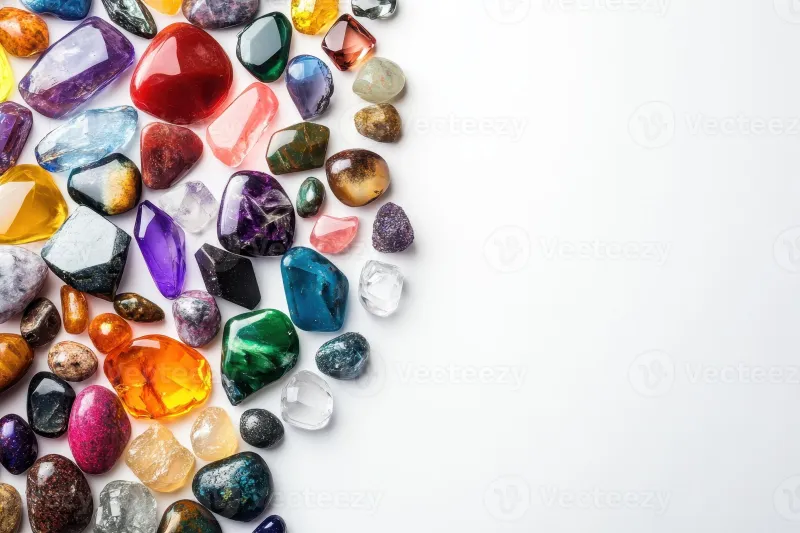
Photo: colorful gemstones assorted collection on neutral background, via static.vecteezy.com
For generations, the answer to "what is your stone?" was straightforward: consult the calendar, locate your birth month, and there it was. January meant garnet. October, opal or tourmaline. The list was tidy, standardized, and largely unquestioned. Today, however, a growing number of Americans are treating that chart as a starting point rather than a destination—or bypassing it altogether in favor of stones that speak to something more particular about who they are.
This shift reflects a broader cultural movement toward personalization in fine jewelry, one in which the meaning behind a piece matters as much as its craftsmanship or material value. Understanding where birthstone traditions come from, and why they are evolving, offers useful context for anyone navigating the expanding world of personal gemstone selection.
A Brief History of Birthstones
The concept of stones linked to specific time periods has roots that stretch back millennia. Scholars trace the earliest connections to the breastplate of Aaron described in the Book of Exodus, which featured twelve gemstones representing the twelve tribes of Israel. Over centuries, those stones became associated with the twelve months of the year and, eventually, the twelve signs of the zodiac.
The modern American birthstone list was formally standardized in 1912 by the American National Retail Jewelers Association—now the Jewelers of America—with subsequent revisions in 1952, 2002, and most recently in 2016, when alexandrite was added as an alternative for June. The list has always been, in part, a commercial framework: a reliable, repeatable reason for consumers to purchase gemstone jewelry as gifts. That origin does not diminish the genuine affection many people hold for their assigned stones, but it does suggest the list was never meant to be immutable.
Why Consumers Are Departing from Convention
Several overlapping trends are driving the move toward personalized stone selection in the United States.
Aesthetic preference is perhaps the most straightforward factor. Many people simply do not love their assigned birthstone. A person born in July may find ruby's deep red beautiful but impractical for their wardrobe, while the pale lavender of amethyst or the oceanic blue of aquamarine speaks more directly to their sensibility. As fine jewelry has become more accessible through online platforms and independent designers, consumers feel increasingly empowered to choose based on what they are drawn to rather than what convention prescribes.
Astrological interest has surged considerably among younger American consumers over the past decade, and with it has come renewed curiosity about stones associated with zodiac signs, planetary rulers, and elemental alignments. These associations differ from the standard birthstone chart and offer an alternative framework for selection. A Scorpio might gravitate toward the deep black iridescence of black tourmaline rather than their calendar-assigned topaz. A Taurus might seek out rose quartz for its Venus associations.
Healing and metaphysical properties represent another driver. While the scientific basis for crystal healing remains unestablished, the cultural resonance of stones associated with specific intentions—labradorite for transformation, citrine for abundance, moonstone for intuition—has expanded considerably in mainstream American culture. Consumers are purchasing gemstone jewelry not only as adornment but as symbolic objects aligned with personal goals or life circumstances.
Family and cultural heritage form a third category of personalization. Some families maintain their own stone traditions passed down through generations, unrelated to any published chart. Others seek out stones associated with their country of origin or ethnic heritage. A person of Colombian descent might choose emerald not because it appears on their birthstone list, but because it connects them to a specific geographic and cultural legacy.
How Designers Are Responding
The fine jewelry industry has been attentive to this shift. Designers who once built their custom work around birthstone requests now routinely invite clients into open-ended conversations about what a stone means to them personally.
Many independent American jewelers now offer what they describe as "intention stones" or "signature stones"—pieces built around a gem chosen through a consultative process rather than a calendar lookup. The conversation might explore color preferences, life themes, upcoming transitions, or inherited jewelry the client wishes to honor. The resulting piece carries a specificity that a standard birthstone ring often cannot.
Designer collections have also reflected this trend. Layered birthstone necklaces—once a straightforward gift category featuring a child's or partner's assigned stone—have expanded into pieces that combine multiple stones representing different relationships, milestones, or values. A necklace might hold a child's birthstone alongside the stone the wearer has chosen for themselves, or three stones selected for their complementary colors rather than any calendar logic.
The rise of alternative and lesser-known gemstones has further enriched this landscape. Stones such as kyanite, sunstone, Ethiopian opal, and parti sapphire—once found primarily in collector circles—are now appearing in fine jewelry sold through curated online platforms. Their relative rarity and visual distinctiveness appeal to consumers who want something that does not look like everyone else's.
Choosing a Personal Stone: A Framework
For those considering a departure from the traditional birthstone chart, the selection process need not be arbitrary. Several questions can help clarify the choice.
What colors do I consistently reach for in my wardrobe and home? Gemstone color is often the most direct path to a stone that will actually be worn. A person drawn to warm terracotta tones might find themselves captivated by fire opal or hessonite garnet. Someone who lives in cool neutrals may prefer the silvery flash of gray moonstone or the icy clarity of blue topaz.
Is there a moment, relationship, or value I want this piece to commemorate? Stones carry associations—historical, cultural, and personal—and choosing one that resonates with a specific meaning can add depth to the jewelry beyond its visual appeal.
What is the stone's practical durability for how I intend to wear it? A stone worn daily in a ring faces different demands than one set in a pendant worn occasionally. The Mohs hardness scale provides useful guidance: sapphire and ruby (hardness 9) and diamond (hardness 10) are well-suited to everyday wear, while softer stones such as opal (5.5–6.5) or moonstone (6–6.5) may require more careful handling.
The Enduring Appeal of Meaning
The birthstone tradition endures because it offers something genuinely valuable: a ready-made connection between a gemstone and the person wearing it. What is changing is not the desire for that connection, but the insistence that it must follow a single prescribed path.
The most meaningful jewelry has always been the kind that tells a true story about its wearer. Whether that story is written by a calendar, a birth chart, a color palette, or a family history, the stone that carries it becomes something more than decoration. It becomes a marker of identity—and that, ultimately, is what fine jewelry has always done best.