The Thoughtful Edit: Auditing Your Jewelry Collection to Rediscover What Truly Belongs
There is a particular kind of quiet discovery that happens when you finally empty your jewelry box completely — a tangle of gold chains from a decade ago, a pair of earrings you adored and then forgot, a bracelet received as a gift that never quite suited you. For many of us, a jewelry collection grows incrementally, piece by piece, without a guiding vision. The result is a drawer full of possibility that somehow never translates into a wardrobe of pieces you actually reach for.
A jewelry audit — the deliberate, unhurried process of assessing every piece you own — is one of the most rewarding exercises a collector can undertake. It is not about minimalism for its own sake. It is about clarity: understanding what you have, what serves you, and what might be reimagined into something that does.
Preparing for the Edit: Create the Right Environment
Before you begin, set the stage thoughtfully. Choose a well-lit space — natural light near a window is ideal — and lay a soft cloth or velvet tray on a flat surface to protect delicate pieces. Gather a loupe or magnifying glass if you have one, a polishing cloth, and small labeled containers or zip-lock bags for sorting.
Empty every jewelry box, travel case, and drawer completely. Include pieces stored in unusual places: the velvet pouch in your coat pocket, the ring sitting on the bathroom counter, the bracelet looped around a drawer pull. A complete audit requires a complete inventory.
Allow yourself adequate time — this is not a thirty-minute task. Approach it as an afternoon of genuine engagement with objects that carry meaning, craftsmanship, and memory.
Assessing Each Piece: Quality, Condition, and Craftsmanship
Begin by examining each piece individually with fresh eyes. Quality assessment starts with the basics: Is the metal marked with a hallmark? Look for stamps such as 925 (sterling silver), 14K, 18K, or 750 (18-karat gold in European notation). Unmarked pieces are not necessarily without value, but they warrant closer scrutiny.
Examine clasps, prongs, and settings carefully. Prongs that hold gemstones should be smooth, evenly spaced, and free of chips or bends. A prong that has worn down to a point can allow a stone to fall loose — a common and preventable loss. Clasps should open and close with firm resistance, neither too stiff nor so loose that they fail to secure properly.
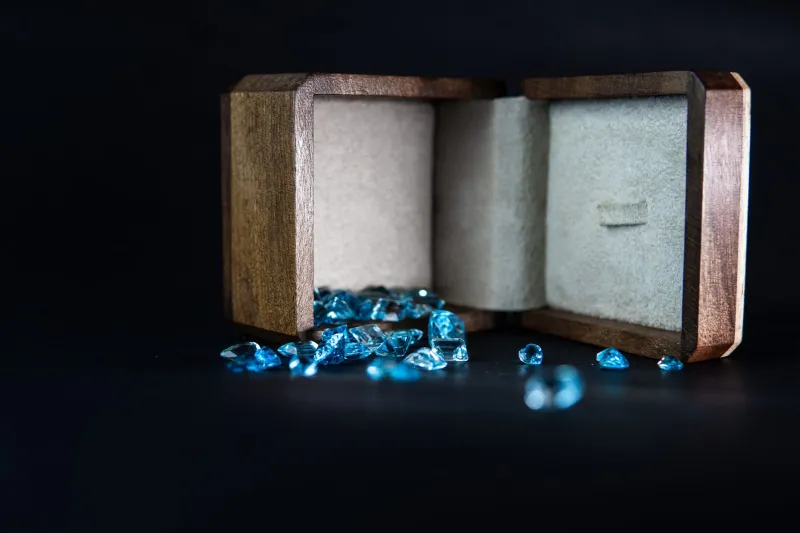
For gemstone pieces, look for chips, cloudiness, or surface scratches. Some stones, such as pearls and opals, are inherently more fragile and may show wear that affects their luster. Others, like sapphires and rubies, are durable enough to be professionally re-polished if minor surface abrasions have accumulated over time.
If you encounter a piece whose metal quality or stone authenticity you genuinely cannot determine, set it aside for a professional appraisal. Many independent jewelers and certified gemologists across the US offer appraisal services, and the investment is well worth making before you decide a piece's fate.
Sorting with Intention: Keep, Transform, or Release
As you work through each piece, assign it to one of three categories:
Keep and Wear: Pieces that fit your current lifestyle, suit your personal aesthetic, and are in excellent wearable condition. These belong front and center in your jewelry wardrobe.
Transform or Restore: Pieces with genuine quality or sentimental value that, in their current state, you simply do not wear. Perhaps a ring no longer fits, a necklace is too long or too short for your current taste, or a brooch feels dated in its setting but contains a stone you love. These are candidates for redesign.
Release: Pieces with no sentimental attachment, low intrinsic value, and no place in your life going forward. These can be sold through consignment, donated, or repurposed for their metal content.
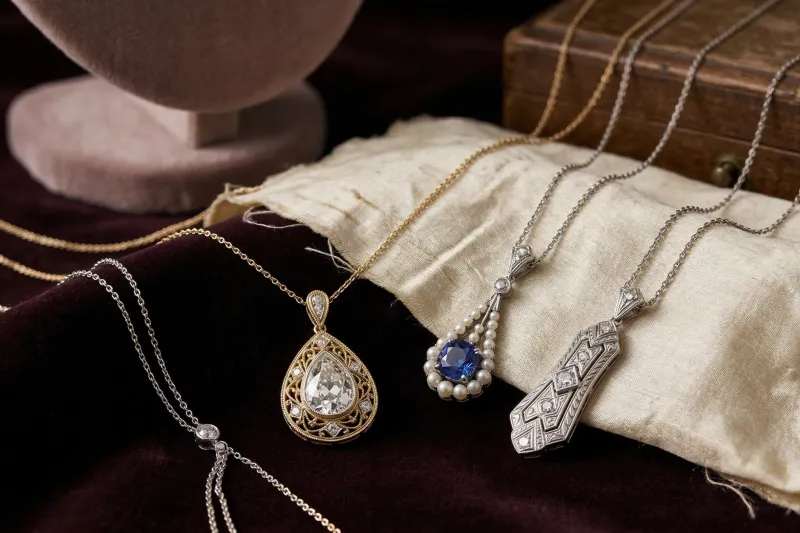
Approach the sentimental category with particular care. Sentiment is a legitimate reason to keep a piece — but it need not mean keeping it in a box where it is never seen or worn. An inherited brooch might become a pendant. A grandmother's ring might be reset into a contemporary band that you would actually slip on each morning.
The Art of Reimagining: Creative Solutions for Forgotten Pieces
Some of the most meaningful jewelry in your collection may be the pieces you have stopped seeing because familiarity has made them invisible. Reimagining these pieces through professional alterations can be genuinely transformative.
Resizing is the most straightforward intervention. A ring that no longer fits your finger due to life's natural changes — weight fluctuation, pregnancy, aging — can almost always be sized up or down by a skilled bench jeweler. Most rings can be adjusted by one to two sizes without compromising their structural integrity or decorative elements.
Resetting stones opens far wider creative possibilities. A cluster of small diamonds from an estate ring might be set into a sleek modern pendant. A colored gemstone from a dated cocktail ring could anchor a fresh bezel-set design that feels entirely current. Speak with a trusted jeweler about what is structurally possible — many will offer sketches or digital renderings before any work begins.
Converting formats is another underused option. Clip-on earrings can often be converted to pierced posts. A long chain can be shortened and the excess metal used to add a new clasp or charm. A brooch with a damaged pin mechanism can be remounted as a pendant.
Before You Add, Know What You Have
Perhaps the most valuable outcome of a thorough jewelry audit is the restraint it inspires. When you know precisely what you own — and have rediscovered pieces you had forgotten — the impulse to acquire simply for the sake of acquiring begins to quiet.
A curated collection of pieces you genuinely love, wear, and care for is infinitely more satisfying than a crowded box of objects competing for attention. The edit, once complete, leaves you not with less, but with more: more clarity, more intention, and more genuine pleasure in the pieces that remain.
At BijOnline, we believe that the most exquisite jewelry is the jewelry that is truly seen — and truly worn. Begin there.