What Your Jewelry Is Actually Worth: Decoding the Appraisal Process for Serious Collectors
There is a moment familiar to many jewelry owners — the one in which a professional appraisal document arrives, bearing a number that seems either implausibly high or unexpectedly modest. That number, whatever it may be, carries significant authority. It shapes insurance premiums, informs estate decisions, and colors how collectors perceive the worth of pieces they may have spent years acquiring. Yet for all its apparent precision, an appraisal figure is frequently misunderstood, and the consequences of that misunderstanding can be both financially and emotionally significant.
The truth is that jewelry valuation is not a single, universal calculation. It is a constellation of methodologies, each designed to answer a different question. Knowing which question your appraiser is answering — and whether it is the right question for your circumstances — is the foundation of genuine financial literacy for any serious collector.
The Three Valuations That Define the Industry
Most collectors encounter appraisals in the context of insurance, and this is where the first and most consequential misunderstanding tends to arise. An insurance replacement value appraisal is designed to answer one specific question: what would it cost to replace this piece, at retail, in today's market? Because it reflects the full retail price of an equivalent item purchased from a reputable jeweler, this figure is almost always the highest valuation a piece will receive. It is also, critically, not what you would receive if you were to sell the piece.
Fair market value, by contrast, represents what a willing buyer would pay a willing seller when neither party is under pressure to transact. This is the standard used in estate settlements, charitable donations, and IRS-related matters such as estate taxes. It tends to fall meaningfully below insurance replacement value, often by thirty to fifty percent, depending on the category of jewelry and prevailing market conditions.
Then there is liquidation value — the figure that reflects what a piece might realistically fetch at auction or through a rapid private sale. For collectors who have ever attempted to sell fine jewelry and been surprised by the offers received, this number explains much of that disappointment. Liquidation value can be a fraction of the insurance appraisal, particularly for pieces whose value is tied to brand prestige or retail markup rather than intrinsic material worth.
Understanding these three figures is not merely academic. A collector who insures a piece at its fair market value, rather than its replacement value, may find themselves significantly undercompensated following a loss. Conversely, one who assumes their insurance appraisal reflects resale potential is likely to be startled when the market responds with considerably less enthusiasm.
Why Two Identical-Looking Pieces Can Carry Vastly Different Values
Perhaps the most illuminating aspect of professional appraisal is what it reveals about the hidden variables that drive value — variables that have little to do with how a piece appears to the untrained eye.
Consider two diamond solitaire rings of apparently identical appearance: same carat weight, similar settings, comparable stones to casual observation. One carries a GIA certificate with a grading report documenting exceptional cut, color, and clarity. The other was purchased decades ago without documentation, and its provenance is unclear. The appraised values of these two pieces may differ by thousands of dollars, and their resale trajectories will diverge even further.
Maker's marks and brand attribution represent another powerful variable. A brooch produced by a notable mid-century American jeweler carries a premium that a visually similar unsigned piece simply cannot command, regardless of material equivalence. The same logic applies to signed pieces from storied European houses. Provenance, in this context, is not sentiment — it is a quantifiable component of value.
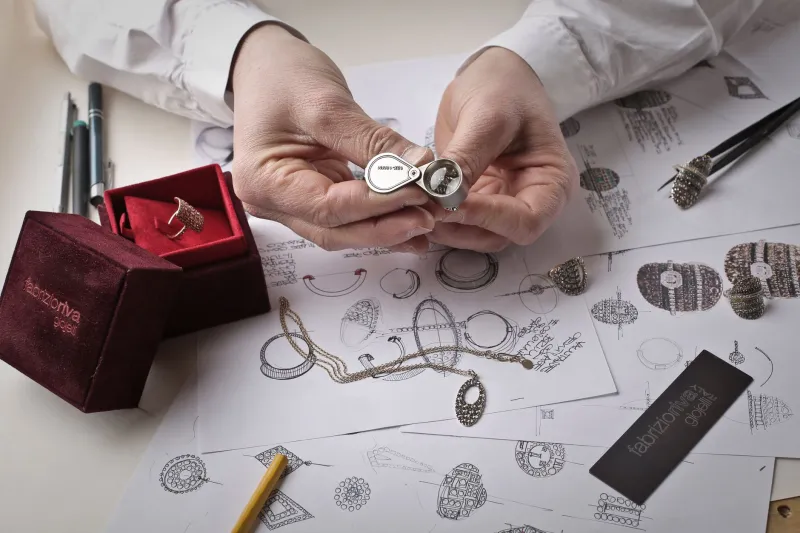
Craftsmanship quality, independent of materials, also plays a defining role. Hand-engraved details, milgrain work executed with exceptional precision, and settings that demonstrate unusual technical sophistication all contribute to appraisal outcomes in ways that a casual inspection cannot capture. An experienced appraiser examines construction under magnification, assessing the quality of workmanship as a distinct category from the value of the materials themselves.
Finally, current market demand for specific styles, periods, and categories can shift valuations meaningfully over time. Art Deco platinum pieces, for instance, have experienced sustained collector interest that has elevated their market value well beyond what their material content alone would suggest. Georgian mourning jewelry occupies a far more specialized market, which constrains both its audience and its liquidity, even when the craftsmanship is extraordinary.
Choosing the Right Appraiser
Not all appraisers are equally qualified, and the credentials behind a valuation matter considerably. In the United States, the most widely recognized professional designations are those conferred by the American Society of Jewelry Appraisers (ASJA) and the Gemological Institute of America (GIA). An appraiser holding a Graduate Gemologist (GG) designation from GIA has completed rigorous training in gemstone identification and grading. Additional credentials from ASJA indicate formal appraisal methodology training beyond gemological knowledge alone.
It is equally important to ensure that your appraiser operates independently — that is, that they have no financial interest in the outcome of the valuation. An appraiser affiliated with a jewelry retailer who also purchases estate pieces may face conflicts of interest that subtly influence their assessments. Fee structures that are based on a percentage of the appraised value, rather than a flat rate or hourly fee, are widely considered a red flag within the professional community.
For significant pieces, seeking a second opinion is not an expression of distrust — it is prudent stewardship. Appraisal is, to a meaningful degree, an interpretive discipline, and reasonable professionals may arrive at different conclusions, particularly for antique, vintage, or one-of-a-kind pieces where comparable sales data is limited.
How Often Should Appraisals Be Updated?
Jewelry valuations are not static documents. Precious metal prices fluctuate — sometimes dramatically — and the collector market for particular styles and periods evolves continuously. An appraisal conducted ten years ago may bear little relationship to current replacement costs or fair market conditions.
Most insurance professionals and estate planners recommend updating appraisals every three to five years for actively worn pieces and more frequently during periods of significant commodity price movement. Gold prices, for example, have experienced considerable volatility over the past decade, and a platinum appraisal from the mid-2000s — when platinum commanded a premium over gold — would require substantial revision to reflect today's relative metal values.
For collectors whose holdings include colored gemstones, updates may be warranted even more regularly. The market for certain stones — Paraíba tourmalines, Burmese rubies, Colombian emeralds of documented origin — has shifted substantially in response to supply constraints and evolving collector preferences.
The Appraisal as a Tool, Not a Verdict
Perhaps the most useful reframe for any collector is to regard an appraisal not as a final statement of worth, but as a professional opinion rendered within a specific context and for a specific purpose. It is a tool — one that serves particular financial and legal functions — rather than an immutable declaration of what a piece means or what it might ultimately command in the right hands, at the right moment, before the right buyer.
The collectors who navigate this landscape most effectively are those who understand which type of valuation they are receiving, why it was conducted, and how it relates to the other figures that might apply to the same piece under different circumstances. That understanding does not diminish the emotional significance of a treasured collection. If anything, it deepens it — by grounding appreciation in knowledge rather than assumption.