Chasing the Rush: How Impulse Jewelry Buying Is Eroding the True Meaning of Luxury
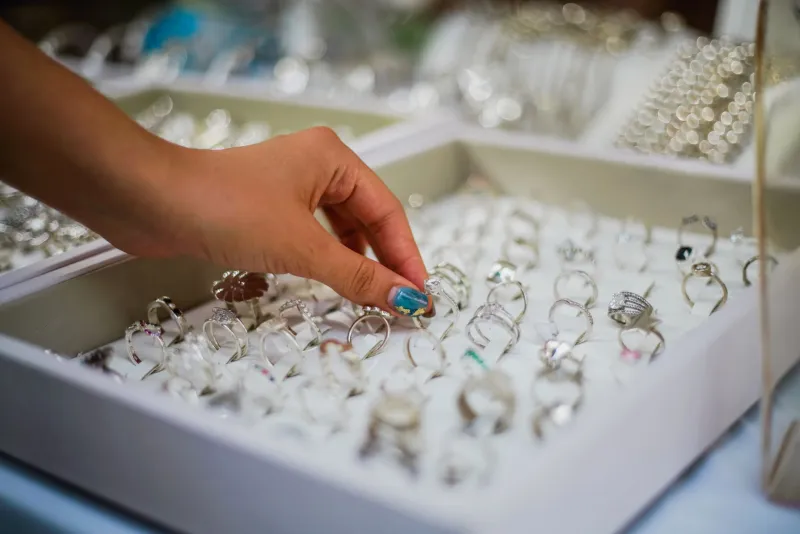
There is a particular kind of pleasure that arrives with a new purchase — immediate, electric, and entirely uncomplicated. You know the feeling. A package arrives. The tissue paper crinkles. Something bright and new sits in your palm, and for a brief, luminous moment, it feels like exactly what you needed. Then, within days or perhaps weeks, it migrates to the back of a drawer, replaced by the anticipation of whatever comes next.
This is the dopamine loop that mass-market jewelry retailers have quietly mastered — and it is reshaping what American consumers believe luxury is supposed to feel like.
The Architecture of a Fleeting High
Behavioral economists have long understood that the anticipation of a reward often generates more neurological excitement than the reward itself. Fast-fashion jewelry brands — and the social media ecosystems that sustain them — have constructed entire business models around this principle. The algorithm surfaces a $38 statement earring. The influencer's reel makes it look aspirational. The checkout process takes under ninety seconds. By the time the piece arrives, the brain has already begun scanning for the next hit.
What gets lost in this cycle is not merely money, though the cumulative cost of dozens of inexpensive acquisitions frequently rivals that of a single well-considered piece. What gets lost is the capacity for genuine appreciation. When everything is accessible, nothing is precious. When every trend is affordable, discernment becomes unnecessary. And when discernment disappears, so does the very foundation upon which luxury is built.
What Mass-Market Jewelry Actually Costs You
The economics of impulse jewelry buying are rarely examined in full. A $50 statement necklace worn twice before it tarnishes is not a bargain — it is an expensive lesson in the difference between price and value. Multiply that transaction across a year of trend cycles, and the figure becomes quietly staggering.
Beyond the financial arithmetic, there is a subtler cost: the erosion of personal aesthetic. A drawer filled with dozens of impulse acquisitions tells no coherent story. It reflects not a collector's vision but the shifting whims of a market designed to manufacture desire rather than satisfy it. The result is a wardrobe of noise — pieces that individually demand attention but collectively communicate nothing.
Contrast this with the collector who spends three months researching a single pair of sapphire earrings, who studies the quality of the setting, the depth of the color, the provenance of the stones. When those earrings finally arrive, the experience is categorically different. The pleasure is not a spike — it is a sustained warmth, the kind that compounds over years of wear and deepens with every compliment received and every memory accumulated.
The Illusion of Abundance
American consumer culture has long conflated quantity with prosperity. More has historically signaled success — more square footage, more options, more things. But among the most discerning collectors, a quiet counter-movement has taken root. The question is no longer how many pieces one owns, but how deeply one knows and values each one.
This is not minimalism for its own sake. It is intentionality — the deliberate practice of acquiring less in order to appreciate more. A single extraordinary brooch, worn with confidence and worn often, communicates far more sophistication than a jewelry box overflowing with pieces that have never earned a second glance.
Luxury, properly understood, has always been about scarcity — not the manufactured scarcity of a limited-edition fast-fashion drop, but the genuine scarcity of something made with exceptional skill, sourced with care, and chosen with conviction.
Recalibrating Your Relationship With Acquisition
Breaking the impulse-buying cycle requires something that the fast-fashion ecosystem actively discourages: patience. Before any acquisition, serious collectors benefit from a simple but demanding practice — waiting. Not the brief pause before clicking confirm, but a genuine interval of days or weeks during which the desire either deepens into conviction or fades into recognition that it was never really there.
During that interval, ask the questions that mass-market marketing is designed to prevent you from asking. Where was this made, and by whom? What is the quality of the metal and the integrity of any stones? Will this piece complement what I already own, or will it simply add to the visual clutter? Can I articulate, in a single sentence, why this particular piece belongs in my collection?
If the answers are satisfying, the acquisition is likely sound. If they are elusive, the impulse is almost certainly not worth indulging.
Redefining the Reward
The dopamine trap is not without a solution, but the solution demands a fundamental reorientation — from the pleasure of getting to the pleasure of having chosen well. This is a subtler and ultimately more durable form of satisfaction. It does not arrive in ninety seconds. It builds slowly, over years of wearing a piece that was selected with care and that continues, season after season, to feel entirely right.
At BijOnline, we believe that every piece in a collection should earn its place — not through trendiness or price point, but through the quality of its craftsmanship, the clarity of its purpose, and the depth of the pleasure it reliably delivers. That standard is, admittedly, a higher bar than a spontaneous online checkout. But it is precisely that elevation of expectation that separates a collection from a drawer full of noise.
The most powerful jewelry statement you can make in an era of abundance is not a bold piece — it is a deliberate one.