The Signature Piece Principle: Why Wearing the Same Jewelry Every Day Is the Ultimate Style Statement
There is a particular kind of confidence that announces itself without a word. You have seen it on the woman who never removes her single strand of pearls, on the architect who wears the same hammered gold cuff to every meeting, on the editor whose stacked signet rings have become as recognizable as her byline. These individuals are not suffering from a lack of imagination. They have arrived, deliberately, at something far more refined: a jewelry uniform.
In a culture that prizes novelty and rewards the perpetual refresh, choosing to wear the same beloved pieces day after day reads as a radical act. Yet it is one of the oldest and most enduring principles of true personal style — and one that the most sophisticated collectors quietly understand.
The Psychology of Repetition and Identity
Psychologists have long noted that consistent personal presentation reinforces a coherent sense of self. When you return to the same piece of jewelry each morning, you are not simply reaching for an accessory. You are reaffirming something about who you are. The act becomes ritualistic, grounding, and over time, deeply meaningful.
This is not a modern observation. Coco Chanel rarely appeared without her layered strands of pearls and gilt chains — not because her wardrobe lacked variety, but because those pieces had become inseparable from her identity. Eleanor Roosevelt wore her three-strand pearl necklace with such regularity that it transcended accessory status entirely; it became part of how the world understood her. More recently, figures from Anna Wintour to Steve Jobs have demonstrated that a carefully chosen uniform — whether in clothing or jewelry — projects authority, intentionality, and an almost enviable sense of self-possession.
The message embedded in repetition is a sophisticated one: I have already made this decision, and I stand by it entirely.
What the Jewelry Uniform Actually Looks Like
A jewelry uniform is not a single piece worn in isolation, nor is it a rigid refusal to ever deviate. Think of it instead as a curated core — two to five pieces that you return to with such frequency that they begin to feel less like ornaments and more like extensions of your physical self.
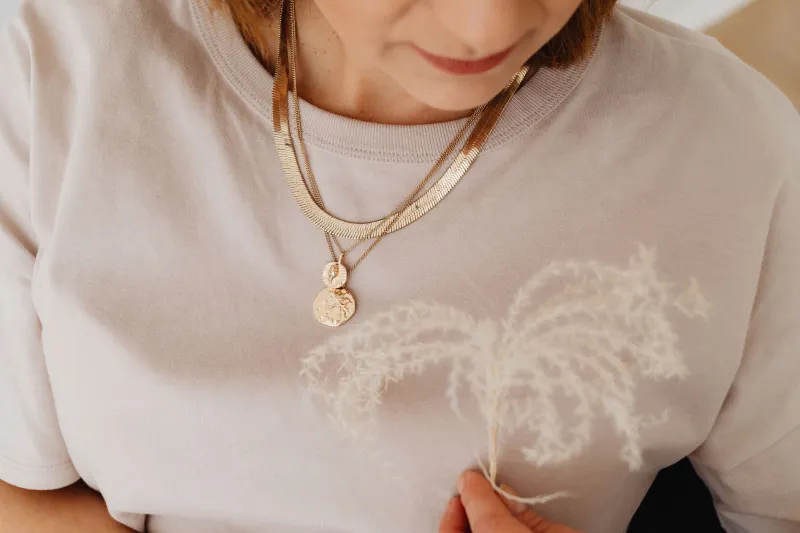
For some, this core is built around a single anchor piece: a yellow gold signet ring engraved with a family crest, a pair of diamond studs that have not left the ears in three years, a delicate tennis bracelet worn from morning coffee to evening dinner. For others, it is a small constellation of pieces that always appear together — a layered chain situation, a stacking ring set, a combination of fine and fashion that has been refined over years of wearing.
The defining quality of a true jewelry uniform is not the monetary value of the pieces, though quality matters enormously to longevity and daily wearability. The defining quality is resonance. These are pieces that feel so intrinsically aligned with your self-image that wearing something outside the rotation feels, as many devoted wearers describe it, like wearing someone else's clothes.
Building Your Own Rotation With Intention
The process of arriving at a jewelry uniform is less about shopping and more about editing. It requires the kind of honest self-examination that many collectors skip in their enthusiasm for acquisition.
Begin by observing your existing habits. Which pieces do you reach for without thinking? Which ones, despite their beauty or price, remain consistently untouched in your jewelry case? The pieces you return to instinctively are already telling you something important. They are the raw material of your signature.
From there, consider the practical dimensions of daily wear. A jewelry uniform must be durable enough to withstand real life — the commute, the meeting, the school pickup, the dinner reservation. This is where material quality becomes not merely an aesthetic preference but a functional necessity. Solid gold holds up where gold-filled will fade. Well-set stones stay put where prong settings catch and snag. Investing in pieces built for endurance is an investment in the uniform itself.
Next, examine coherence. Your core pieces need not match in a literal sense, but they should share a tonal language — whether that is a consistent metal family, a recurring motif, a shared scale, or simply an alignment in sensibility. The goal is a rotation that reads as intentional rather than arbitrary, even when viewed from the outside.
Finally, allow for evolution. A jewelry uniform is not a sentence. It is a living document. Pieces may enter the rotation as your tastes mature or as life circumstances shift — a new decade, a new city, a new chapter. What the uniform requires is not permanence, but commitment while you are in it.
The Collector's Paradox: Owning More, Wearing Less
There is a certain irony that many serious jewelry collectors eventually confront. The larger and more impressive the collection grows, the less any single piece is worn. Pieces that were once daily companions become occasional visitors, rotating in and out on a schedule that dilutes the intimacy between wearer and object.
This is not to argue against collecting — the intellectual and aesthetic pleasures of building a meaningful collection are real and considerable. But it is worth asking what purpose jewelry ultimately serves. At its most fundamental, a piece of jewelry exists to be worn, to be seen, to carry meaning in the world. A piece that spends most of its existence in a velvet-lined drawer is a beautiful object, certainly. But it is not yet fully alive.
The jewelry uniform offers a counterpoint to this tendency. By committing to a small rotation worn with genuine frequency, you deepen the relationship between yourself and each piece in ways that occasional wearing simply cannot replicate. The gold chain that has traveled with you through three cities and a decade of mornings carries a different weight than the statement necklace worn twice to events. Both have value. But only one has become truly yours.
The Quiet Authority of a Consistent Presence
There is something that happens when you are known for a piece. Colleagues begin to associate it with you. Friends notice when it is absent. Over time, the piece becomes part of your social presence — a visual shorthand for your sensibility, your taste, your way of moving through the world.
This is the deepest argument for the jewelry uniform. Beyond the psychological benefits, beyond the practical advantages of simplifying morning decisions, beyond even the beauty of the pieces themselves, lies the remarkable possibility of becoming someone who is recognized — not for what you wore last season, but for what you wear every single day.
In a landscape saturated with options, the decision to stop endlessly seeking and instead commit fully to what already resonates is not a limitation. It is a declaration. And declarations, made in gold or silver, pearl or stone, have a way of lasting far longer than trends.
Your signature is already forming. The question is simply whether you are paying close enough attention to recognize it.