What the Eye Misses First: A Collector's Guide to Reading True Quality in Fine Jewelry
There is a particular moment that experienced collectors describe in almost identical terms: the instant they picked up a piece and felt, before they could articulate why, that it was different. Not simply beautiful — beautiful is easy — but substantial in some quieter, more compelling way. That sensation is not mystical. It is the accumulated intelligence of materials, technique, and intention rendered into physical form. And it can be learned.
The fine jewelry market in the United States is saturated with pieces that photograph extraordinarily well and perform disappointingly in person. Marketing language — words like "artisanal," "luxury," and "investment-grade" — has been so liberally applied that it no longer serves as reliable guidance. What does serve as guidance are the tangible, observable, and measurable qualities that skilled jewelers and seasoned collectors use to evaluate a piece before a single dollar changes hands.
This is a guide to developing precisely that kind of sight.
Weight as a First Language
Before examining any detail, lift the piece. Weight communicates immediately. Fine jewelry made with genuine precious metal carries a density that plated or hollow constructions simply cannot replicate. A well-fabricated 18-karat gold bracelet feels purposeful in the hand — not heavy in an unwieldy sense, but present. Pieces that feel insubstantial relative to their visual size are often constructed with thin gauge metal, hollow forms, or base metal cores. None of these are inherently dishonest, but none of them are investment-grade either.
This principle extends to gemstones. A well-cut natural stone of meaningful carat weight contributes to the overall heft of a piece in a way that glass simulants and synthetic alternatives do not. Weight is not the final word on quality, but it is frequently the first honest one.
The Finish Beneath the Surface
Most buyers examine the front of a piece. Experienced collectors turn it over.
The reverse of a well-made jewelry item reveals as much about craftsmanship as the face. Look for consistent metal thickness, clean solder points that are nearly invisible, and prong tips that are smoothly rounded rather than sharp or uneven. On rings, examine the interior of the band: it should be uniformly polished, free of tool marks, and comfortable against the skin without rough seams. On necklaces and bracelets, inspect the clasp mechanism — it should engage with a satisfying, precise click and release cleanly without force.
Finishing work on the underside of a piece costs time and therefore money. Manufacturers cutting corners do so here first, knowing most consumers will never look. That invisibility is precisely why it matters so much as a quality indicator.
Prong Work and Stone Setting: Where Technique Becomes Visible
The setting is the structural relationship between metal and stone, and it is one of the most revealing sites of quality assessment in all of fine jewelry.
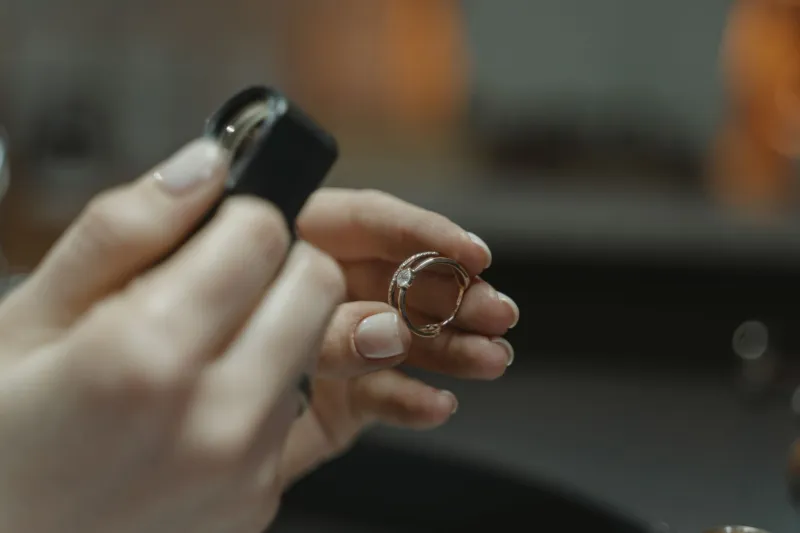
Examine prongs under magnification if possible — many fine jewelers will accommodate this request without hesitation, and any reluctance to do so is itself informative. Prongs should be uniform in height and thickness, positioned symmetrically around the stone, and curved to follow the stone's contour rather than simply gripping it mechanically. The tips should be rounded and burnished, never pointed or jagged, which would catch on fabric and signal hasty workmanship.
Bezel settings, which encircle a stone with a continuous band of metal, should show an even, consistent wall height with no gaps between metal and stone. Pavé and channel settings should present stones that sit flush and level, with no visible gaps, no stones sitting higher than their neighbors, and bead work that is clean and consistent.
A stone that moves when pressed lightly — even fractionally — indicates a setting that will not hold over time. This is not a minor concern. A loose stone is a lost stone, and the cost of replacement frequently exceeds what a buyer imagined they were saving by purchasing a lesser piece.
Metal Hallmarks and What They Actually Confirm
Hallmarks are the jewelry industry's most underutilized consumer tool. In the United States, federal law requires that any item sold with a karat designation be stamped accordingly, and reputable manufacturers comply fully and consistently. On fine pieces, you should be able to locate a legible stamp indicating metal purity — 750 for 18-karat gold, 925 for sterling silver, 950 for platinum — often accompanied by a maker's mark.
The absence of a hallmark on a piece represented as precious metal is a significant red flag. Faded, illegible, or inconsistently placed stamps warrant careful scrutiny. On antique and estate pieces, hallmarks become even more informative, often encoding the country of origin, year of manufacture, and assay office, details that speak directly to provenance and historical value.
Platinum deserves particular note. It is denser, rarer, and more durable than gold, and it commands a premium that is entirely justified for serious collectors. A platinum piece will feel noticeably heavier than a gold piece of equivalent volume. Its color is naturally white and does not require rhodium plating to maintain its appearance over time, a distinction that matters considerably for long-term wearability.
Gemstone Grading: Reading Beyond the Certificate
Gemological certificates from institutions such as the Gemological Institute of America (GIA) or the American Gem Society (AGS) provide essential documentation for significant stones, but a certificate describes a stone at a single point in time. The ability to read quality directly — to see it — remains a distinct and valuable skill.
For diamonds, the four Cs (cut, color, clarity, and carat weight) are well established, but cut is frequently underweighted by buyers focused on size. A well-cut diamond of modest carat weight will outperform a larger stone with a mediocre cut in virtually every lighting condition. Look for brilliance that is distributed evenly across the stone, not concentrated at the center or edges. Observe the stone under different light sources: natural daylight, incandescent light, and fluorescent light each reveal different aspects of a stone's character.
For colored gemstones — sapphires, rubies, emeralds, and the expanding universe of collector favorites including alexandrite, paraíba tourmaline, and Kashmir-origin stones — color saturation, tone, and hue consistency are primary. Natural, untreated stones command meaningful premiums, and disclosure of any heat treatment or clarity enhancement should be standard practice from any reputable seller.
Construction Methods: Handmade, Cast, and Everything Between
Contemporary fine jewelry is produced through several methods, each with distinct quality implications. Hand-fabricated pieces — constructed from sheet metal and wire by a skilled jeweler working directly with the material — represent the highest level of technical investment. They are typically stronger at stress points, more precisely fitted, and carry the subtle irregularities that distinguish human craft from mechanical reproduction.
Cast pieces, produced by pouring molten metal into a mold, are the industry standard for most production jewelry. Quality varies enormously within this category: a well-cast piece from a reputable manufacturer, finished by hand, can be exceptional. A poorly cast piece will show porosity (tiny surface bubbles), inconsistent metal density, and finishing that cannot fully conceal its origins.
Ask questions. A jeweler who can speak fluently about how a piece was made — who fabricated it, where the stones were sourced, how the setting was executed — is a jeweler who knows what they are selling. That knowledge, and the willingness to share it, is itself a quality indicator worth weighing.
The Education That Never Ends
Developing a discerning eye for fine jewelry is not a weekend project. It is an ongoing education built from handling pieces, asking questions, visiting independent jewelers and auction houses, and allowing your hands and eyes to accumulate the kind of experiential knowledge that no photograph can convey.
The pieces that will matter most in your collection — the ones that hold their value, survive generations, and carry meaning that deepens with time — are rarely the ones that caught your attention first. They are the ones that rewarded a second look, a careful touch, and the willingness to ask what lies beneath the surface.
That is the jewelry worth waiting for.