New Rules, New Stones: How a Rising Generation Is Reshaping the Meaning of Fine Jewelry in America
For most of the twentieth century, the grammar of fine jewelry in America was written by a relatively small number of institutions. The major houses set the aesthetic standards. The mining industry established the material hierarchy. The bridal market determined which occasions warranted significant acquisition. And the consumer, by and large, understood their role as one of aspiration toward a pre-existing ideal.
That arrangement is under considerable pressure. The generation now entering its peak earning and collecting years — broadly encompassing millennials and the older cohort of Gen Z — did not inherit the same relationship to these institutions, these materials, or these occasions. They arrived at the jewelry market as informed skeptics, shaped by a decade of supply chain transparency reporting, environmental reckoning, and a cultural disposition toward individuality that sits uneasily with the idea of a universal luxury standard.
The result is not a rejection of fine jewelry. It is, in many respects, a deepening of engagement with it — on entirely different terms.
The Lab-Grown Question: Value Redefined
No single development has generated more debate within the fine jewelry industry over the past five years than the rapid mainstream acceptance of laboratory-grown diamonds among younger collectors. Where the previous generation largely accepted the premise that a mined diamond's value was inseparable from its geological origin, a significant portion of millennial and Gen Z buyers have reached a different conclusion: the optical, chemical, and physical properties of the stone are what matter, and those properties are identical whether the diamond formed beneath the earth over millennia or within a controlled environment over weeks.
The financial dimension of this position is not incidental. Laboratory-grown diamonds currently trade at a substantial discount to their mined equivalents, allowing younger collectors to acquire stones of exceptional size and quality at price points that would have been inaccessible in a mined-only market. The savings are frequently redirected into the setting — commissioning bespoke metalwork from independent designers that would be prohibitively expensive if the stone budget had been consumed by a mined stone.
The long-term resale value of laboratory-grown diamonds remains a genuinely open question, and it is one that any serious collector should weigh carefully. However, many younger buyers approach this concern with a different framework: they are acquiring for personal significance and present enjoyment rather than for generational transfer of monetary value. This is not financial naivety — it is a conscious values choice that reflects a broader shift in how this cohort thinks about luxury.
Provenance as a Non-Negotiable
If younger collectors are more flexible than their predecessors about material origin in the case of laboratory-grown stones, they are considerably more demanding when it comes to the ethical dimensions of mined materials. Supply chain transparency — knowing where a stone was extracted, under what labor conditions, and through what chain of custody — has moved from a niche concern to a baseline expectation among a meaningful segment of the market.
This has created significant opportunity for smaller, independently operated jewelers who have built their businesses around traceable sourcing. Designers working with certified fair-trade gold, conflict-free colored gemstones from known mines, and recycled precious metals have found receptive audiences among younger collectors who are willing to pay a premium for documentation of ethical practice.
The irony is not lost on industry observers that this demand for provenance — the insistence on knowing the full story of a material — is in many respects a more rigorous form of connoisseurship than the provenance-indifferent collecting that preceded it. The question has simply shifted from where was this designed? to where did every component originate, and at what human cost?
The Independent Designer as the New House
Perhaps the most structurally significant shift in how younger collectors engage with fine jewelry is their orientation toward independent studio designers rather than established houses. The democratization of discovery — through social platforms, independent editorial, and direct-to-consumer e-commerce — has made it possible for a jeweler working from a studio in Portland, Oregon, or Marfa, Texas, to build a devoted national following without the infrastructure or retail footprint that once defined credibility in the category.
Younger collectors have embraced this with notable enthusiasm. There is genuine cultural capital, within this cohort, in wearing a piece by a designer whose work is not yet widely recognized — in being, in some sense, ahead of the market. This is a form of connoisseurship that has long existed in the fine art world but is relatively new to jewelry collecting in America.
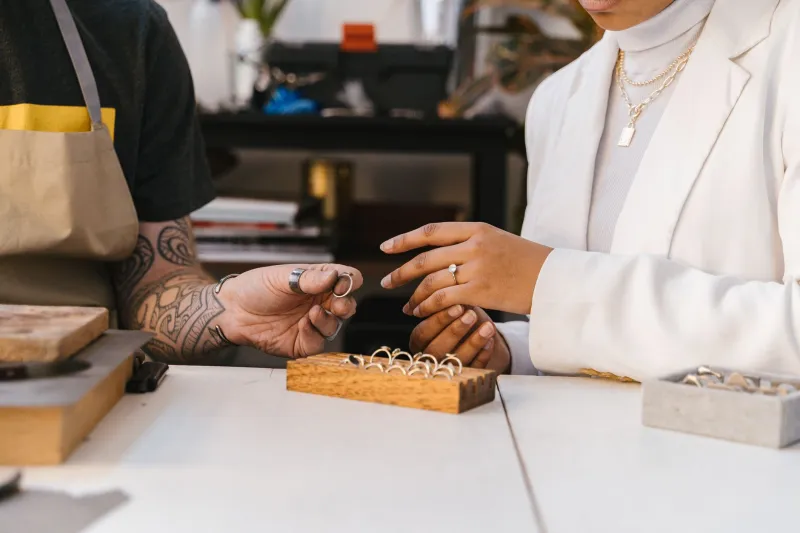
The independent designers attracting the most serious younger collectors share certain characteristics: a distinctive and coherent visual language, a transparent creative process, a commitment to quality materials, and a willingness to engage directly with their clients. Many offer bespoke or semi-custom work as a central part of their practice, which aligns precisely with younger collectors' preference for pieces that feel genuinely singular.
Unconventional Materials and the Expansion of Fine
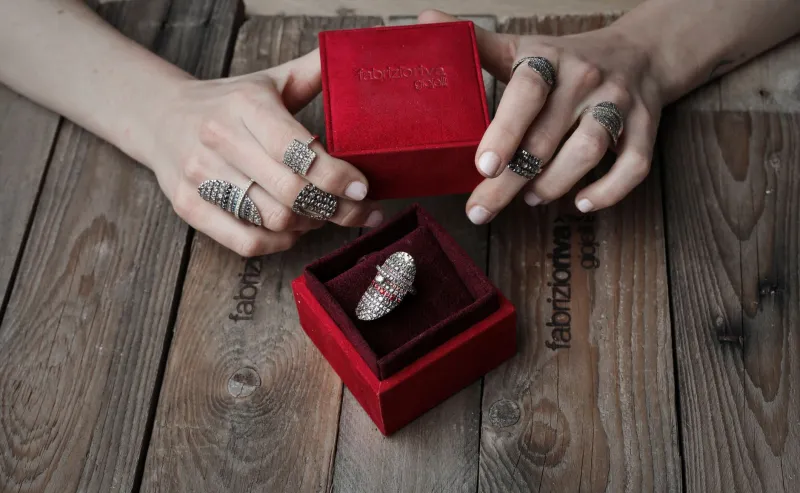
The definition of what constitutes a "fine" material is also under active renegotiation. While gold and platinum retain their primacy, younger collectors have demonstrated a genuine appetite for materials that previous generations would not have considered within the category: oxidized silver worn intentionally and maintained as such, blackened metals, raw or minimally processed gemstones, concrete, resin, and wood incorporated into high-quality settings.
This is not a departure from craft — in many cases, working these materials to a fine jewelry standard requires exceptional technical skill. It is, rather, an expansion of the aesthetic vocabulary of the category, driven by collectors who do not feel bound by the traditional hierarchy of materials.
Evolution or Revolution?
The question most frequently posed by established participants in the fine jewelry market is whether what younger collectors are doing represents a genuine paradigm shift or simply a generational inflection that will eventually resolve into something closer to the existing order as this cohort ages into greater affluence.
The honest answer is that it is likely both. Some preferences — the appetite for independent designers, the demand for ethical sourcing — are almost certainly durable, because they are expressions of values rather than aesthetic whims. Others — the strong preference for laboratory-grown stones over mined — may evolve as the secondary market matures and the long-term value trajectory becomes clearer.
What is not in question is that the fine jewelry market in America is being permanently broadened. The definition of luxury is expanding to accommodate new materials, new sources of credibility, and new reasons for acquisition. For collectors and retailers alike, the appropriate response is not defensiveness but curiosity — because a category that is genuinely evolving is a category that remains alive.